The Power of Micro Habits: "Big Changes Come from Small Habits"
Introduction
Leaving the scorching summer days behind, we've now entered crisp autumn weather, a time when a warm cup of tea becomes ever so comforting. Haven't you found yourself making resolutions like, "Now that the weather's cooler, I'll definitely start exercising every morning from tomorrow!" or "I'll study for two hours every evening after work to challenge myself with a new certification!"? It's often around seasonal changes or the turn of the year that we dream of dramatic, grand transformations and set ambitious plans. However, sadly, most grand plans often fall apart within a few days or weeks. I was no exception. When enthusiasm soared, I'd embark on challenges as if I could change my entire life, only to quickly confront reality's barriers, despairing, "Why am I like this?" I'd blame myself, and slowly, fade back to my old self.
One day, as I held the steering wheel on my drive home, feeling heavy-hearted, I listened to some meditation music on the radio and took a moment to breathe. I noticed that my cluttered mind started to clear up, even if just a little. It was then that I realized 'catching my breath' had already become my small habit. That's when it clicked: what truly changes my life isn't a monumental decision, but a very tiny habit. Instead of grand goals, a very small start. This is the "power of micro habits" that I want to discuss with you today. Following the 'Catching Your Breath' series, I'd like to embark on a new series, 'Today's Small Courage for Tomorrow's Change,' to realize the belief that these small seeds, when gathered, will someday form an elegant and beautiful forest.

The Power of Micro Habits: "Big Changes Come from Small Habits"
We all dream of a better self, but it's easy to assume that the process requires immense willpower. However, BJ Fogg, a behavioral scientist, author of Tiny Habits, and director of the Stanford Behavior Design Lab, states that "change doesn't require willpower; it requires a system." His behavior model (B=MAP: Behavior = Motivation x Ability x Prompt) explains that behavior occurs when three elements are met simultaneously: Motivation, Ability, and Prompt. That is, for us to successfully perform an action, we need sufficient motivation to do it, the ability to perform it, and an appropriate prompt to initiate it.
The key here is Ability. Even if motivation is low, if you drastically lower the target for the required ability to perform an action, the behavior will occur. For example, no matter how much motivation you have to "start exercising," "exercising for an hour at the gym every day" demands enormous ability—time, physical stamina, and willpower. That's why Dr. Fogg advises starting habits with actions so small that you "cannot fail." These are micro habits. The idea is to design habits that can be completed in just two minutes a day, or even less—something tiny and incredibly easy to do.
The reason we often set grand goals and fail is that we focus solely on motivation without properly lowering the "ability" hurdle. If your goal is "exercise for 30 minutes a day," you might easily give up due to lack of time or fatigue. But what if you started with a tiny action like "putting on your workout clothes for 2 minutes" or "doing one push-up for 10 seconds"? We can perform these actions daily without much burden, and these small successes give a positive reward signal to the brain, motivating us to move on to the next step.
Neuroscience explains that habits are stored in a brain structure called the basal ganglia. While starting a new habit requires conscious effort (prefrontal cortex), repeating it automates the process, saving brain energy. In other words, while "willpower" is needed initially, over time it solidifies into a "routine" that is performed effortlessly.
Thus, micro habits are powerful tools for building consistency while minimizing the use of willpower. Instead of the pressure of "having to do," they provide daily doses of "I can do this" confidence, positively stimulating the brain's dopamine reward system and naturally building a foundation for moving towards larger actions.
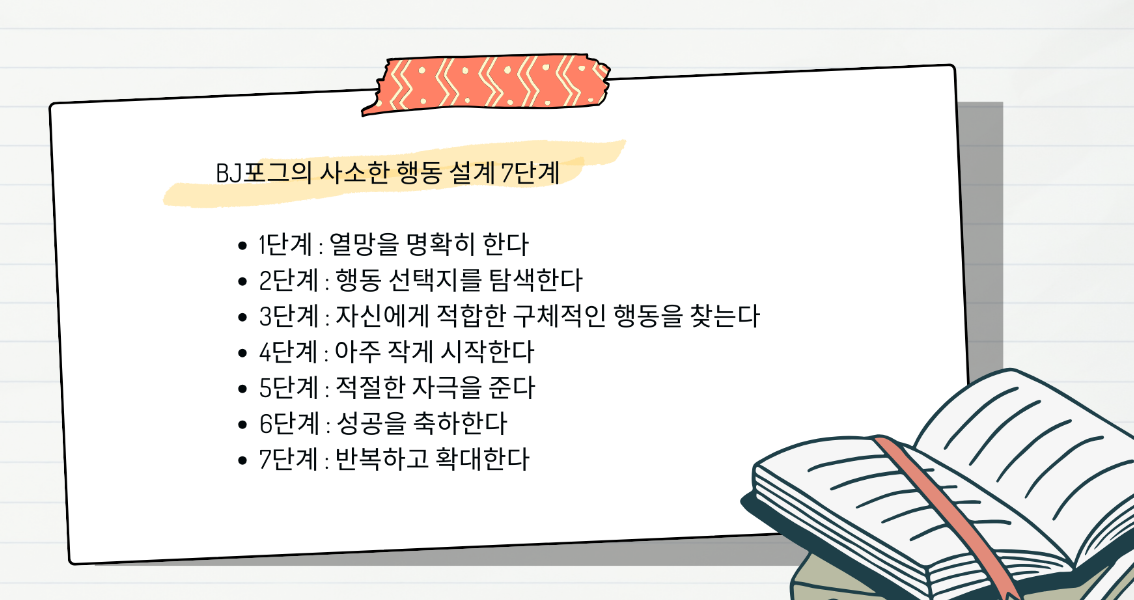
Habit Design Methods for Daily 2-Minute Practice: Concrete Action Tips
So, how can we successfully integrate these micro habits into our lives? Through these three key strategies, invite a gentle breeze of change into your daily routine.
- Start ridiculously small: To the point where it 'cannot be easier'!" : This is the most crucial and fundamental principle. The core is to break down your target habit into such small pieces that you might even wonder, 'Will this really be effective?' We tend to aim for perfection, but when building new habits, making them "as easy as possible" is the shortest path to success.
- Success Story: Creating a Small Personal Success Routine Ms. Kim, an office worker, aimed to wake up early every morning to exercise, but always failed. Her goal of "waking up at 5 AM to go to the gym" was too monumental. After encountering BJ Fogg's micro-habits theory, she revised her goal to: "When the alarm rings, simply put my feet on the floor and sit up from bed (takes 5 seconds)." At first, she only managed to sit up. But as she consistently did this small action daily, she started thinking, 'Now that I'm up, it's a shame to just lie back down,' and this naturally led to drinking a glass of water and doing 2 minutes of stretching. Now, she consistently maintains a routine of waking up at 5 AM and doing light exercise for about 20 minutes. A tiny 5-second habit of putting her feet on the floor completely transformed her mornings.
- Failure Story: The Trap of Perfectionism with 'This Much is a Must' Mentality Mrs. Park, a homemaker, set a goal of "reading 10 pages of a book every night before bed" for consistent reading. While it was a good goal, 10 pages felt like an enormous burden on tired nights after putting her children to sleep. Eventually, she found herself closing the book most nights with self-reproach, 'I couldn't read again today,' and her reading habit failed before it even truly began. This is a classic failure caused by focusing too much on 'results' from the start. Mrs. Park only truly befriended reading when she changed her goal to 'read at least one sentence aloud from a book every day.'
- Celebrate immediately after the action: So your brain remembers it as a 'good experience'!" : If you successfully perform a small habit, immediately praise and celebrate yourself. This process is a powerful mechanism that activates the brain's dopamine reward system, causing it to recognize the action as positive. It doesn't have to be a special event. Self-encouraging words like 'Well done!', 'Amazing!', 'That's my spirit!', a quick smile, or a fist pump—anything that brings you a sense of satisfaction is good.
- Success Story: The Joy of Self-Encouragement Freelancer Ms. Lee suffered from severe back pain due to her habit of sitting all day. So, she adopted the micro habit of "standing up and stretching for 1 minute every hour." When her alarm went off, she'd stand up from her computer, stretch, and then clap for herself, saying, 'Yay! You're the best!' At first, it felt awkward, but she noticed that each time she praised herself, she actually felt better. Thanks to this, she consistently practiced stretching, which reduced her back pain and improved her work concentration. This was the result of her brain receiving positive feedback for a small action.
- Failure Story: Overlooking Rewards by Focusing Only on Results Mr. Choi, an office worker, aimed to "climb one flight of stairs" after lunch. However, he never praised himself, thinking, 'What's the big deal with just one flight?' Even after successfully doing it several times, he felt no great satisfaction, and eventually, the thought 'It's bothersome' grew, preventing it from becoming a habit. While completing the action itself is important, the process of helping the brain perceive that action as 'enjoyable,' that is, the reward, should never be overlooked.
- Connect new habits to existing ones: Create natural triggers!" : 'When creating a new habit, connecting it to an already established habit significantly increases the chances of success. The idea is to add a new action after a behavior your brain is already familiar with, creating a natural flow. Dr. BJ Fogg calls this an Anchor Habit. The anchor habit serves as a prompt to perform the new micro habit.
- Success Story: Naturally Integrated Healthy Habits Mrs. Kwon, a homemaker interested in health, wanted to drink enough water daily but often forgot. She tried, "After drinking my morning coffee, immediately take a sip of water." "Drinking coffee" was her solid anchor habit. The moment the aroma of coffee reached her nose, she would automatically reach for her water glass, and drinking enough water each day became much easier. She also created successful habits by linking other anchor habits, such as "stretching for 1 minute after brushing teeth."
- Failure Story: Unconnected Attempts and Frequent Omissions Student Kim wanted to develop a habit of stretching before starting his studies. However, he set his goal as "stretching at 6:30 PM." 6:30 PM was a fluid time each day, and it didn't align well with the anchor habit of 'before starting studies,' so he often missed it. Consequently, it became an 'if I remember, I'll do it; otherwise, I won't' situation. When building new habits, it's crucial to find predictable and regular 'anchor habits.
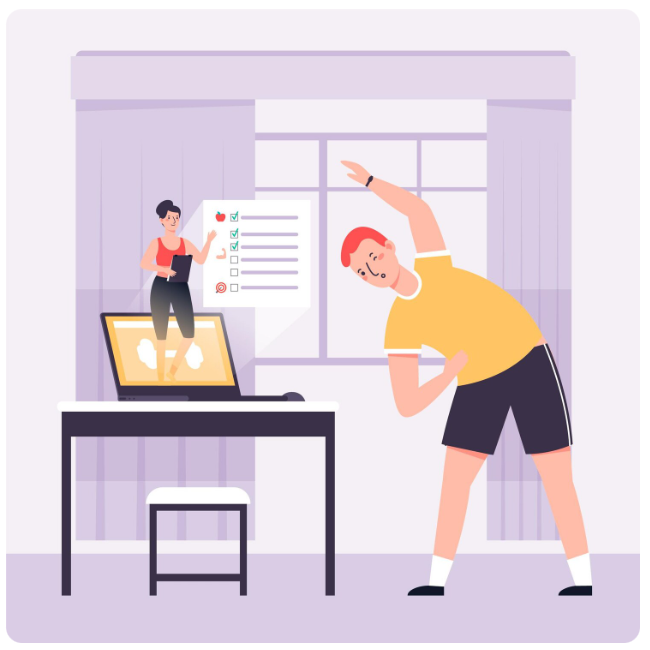
Frequently Asked Questions (FAQ)
Q1: Are micro habits, being so easy, truly effective?
A1: Yes, absolutely! The essence of micro habits is 'building small, impossible-to-fail success experiences every day.' These small successes provide positive reinforcement to the brain, motivating you to move to the next step, and through consistency, gradually increase the scale of your actions. Though they may seem small at first, when maintained consistently, they create tremendous change.
Q2: What should I do if I fail?
A2: Failure is merely part of the process. The important thing is not to blame yourself but to start again. Even if you skipped your micro habit yesterday, you can start again today. Micro habits are designed to minimize the burden of failure, so 'starting again' can be considered the easiest habit of all. Having a flexible mindset that 'I can start again' is crucial.
Q3: It's difficult to be consistent. I often need motivation.
A3: Micro habits are designed to be initiated without willpower or high motivation. Rather than focusing on motivation, concentrate on 'environmental design.' Creating an environment conducive to starting the habit and removing obstacles is more effective. For example, if your goal is to drink water, place a water cup somewhere always visible. Additionally, self-praise and rewards for small successes become the most powerful motivators.
Q4: Once one micro habit is established, what should I do next?
A4: Once a micro habit has successfully taken root, you can either expand its 'size' or add another micro habit. For example, if 'tying shoelaces for 2 minutes' has been successful, you can expand it to 'walking for 5 minutes with shoes on.' Or, you can start a completely new micro habit (e.g., 'reading one sentence from a book') by connecting it to an existing habit (e.g., after dinner). Always remember the principle of 'starting small.'
🌟 A Word for Your Action Practice
"You don't need to strive to be an extraordinary person who changes the world. If you have the courage to consistently perform small actions, the world will notice you on its own."
🌷 In Conclusion
Today, we've explored the magical concept of 'micro habits.' Sometimes, consistently creating gentle ripples is far more powerful in bringing about change than attempting to overcome massive waves. I firmly believe that small actions of just two minutes a day, or perhaps even less, will collectively bring positive butterfly effects to our daily lives. May this simple truth that 'big changes come from small habits' take deep root in your life, becoming a solid stepping stone for all the goals you wish to pursue. In our next edition, we'll discuss 'Overcoming Anxiety Through Action.' I believe that the small courage you begin today will create tomorrow's big change.
( 이 글은 '내일을 바꾸는 오늘의 작은 용기 시리즈:1편. 작은 습관의 힘'의 영어 번역 버전입니다. 원본은 아래 링크를 확인해주세요.)
😊내일을 바꾸는 오늘의 작은 용기 시리즈:1편. 작은 습관의 힘
인트로 무더웠던 여름날을 뒤로하고 어느덧 따뜻한 차 한 잔이 그리워지는 쌀쌀한 가을날이 되었네요. '이제 날씨도 선선해졌으니 내일부터는 꼭 매일 아침 운동을 시작해야지!', '퇴근 후 매일
kiheo.tistory.com